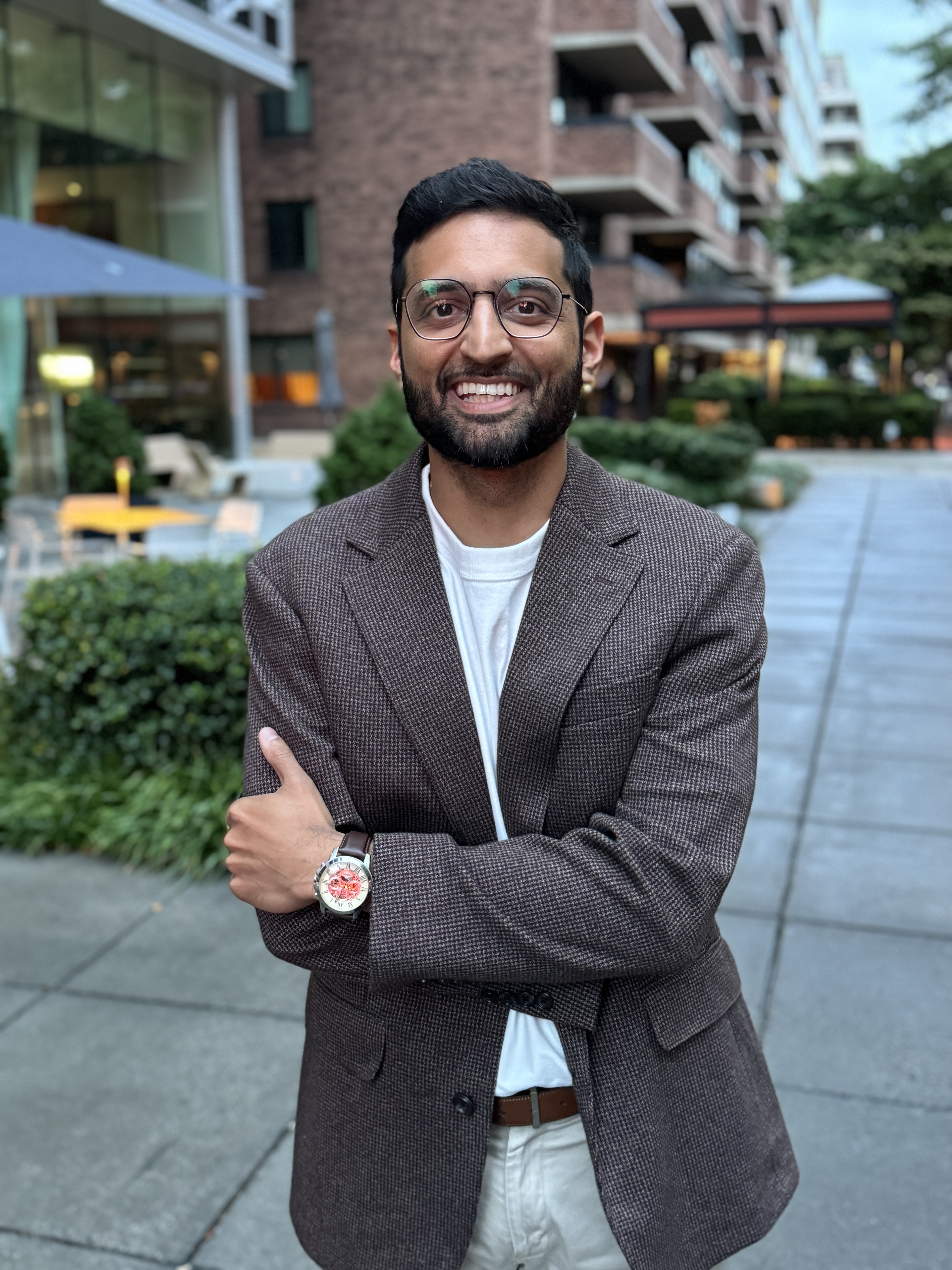
Welcome! My name is Amaan Charaniya, and I'm currently a Postdoctoral Fellow in the Security & Conflict Lab at Emory University. In Spring 2027, I will join the Department of Political Science and Public Administration at the University of North Carolina, Charlotte, as an Assistant Professor of Political Science.
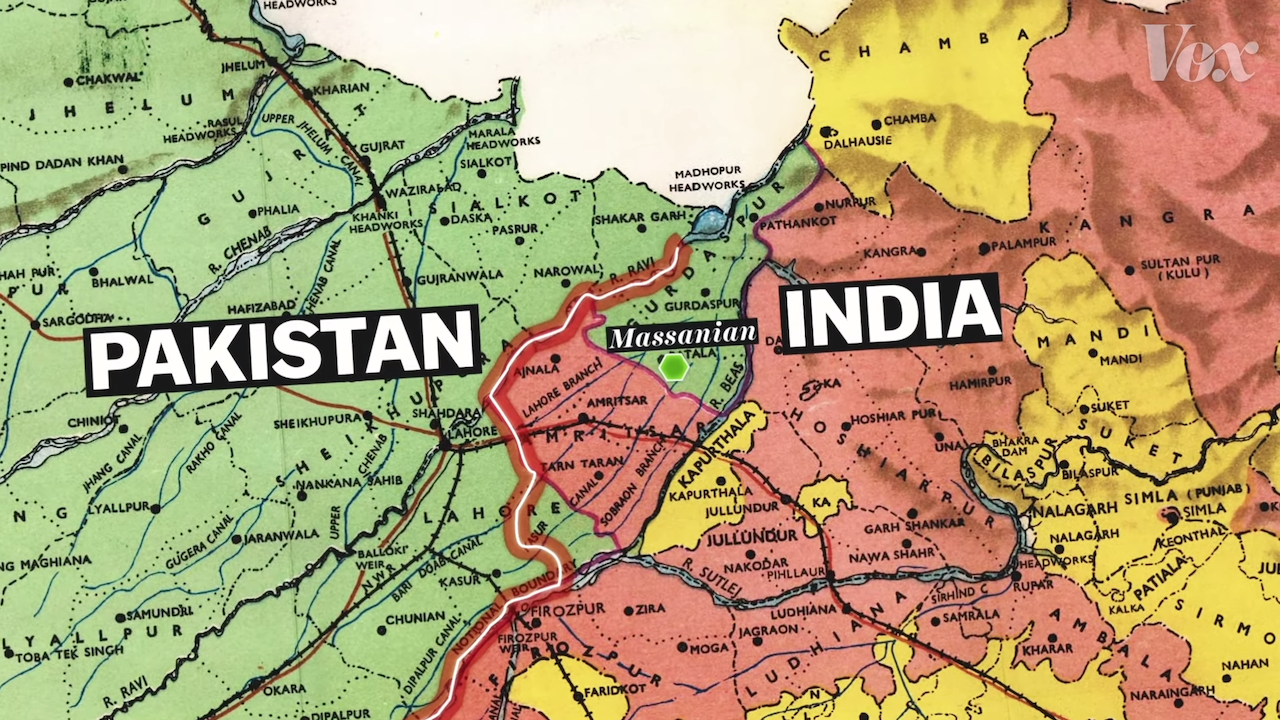
I am an international relations scholar primarily interested in international conflict, territorial disputes, and domestic public opinion. In my research, I examine when states fight over territory and how these conflicts shape the foreign policy views of domestic audiences. I explore these ideas primarily in South Asia.
In my dissertation, I used original survey experiments in India to investigate how territorial conflict with Pakistan shapes public views about peace negotiations and conflict with India's other adversaries and neighbors. I find that violence has spillover effects in domestic public opinion by sharply increasing hawkish public opinion towards all of India's neighbors. In other working projects, I explore the historical origins of border instability, Hindu-Muslim relations after border conflict, and voting behavior in borderlands.
I received my Ph.D. in political science from Washington University in St. Louis and my undergraduate degrees in International Affairs and Economics from the University of Georgia in Athens, GA. My CV is available here.
Outside of my research, I enjoy road cycling, reading fiction, coffee, watching films, and scrolling through basketball reference pages.
Research
Under Review
-
1."Whose Line is it Anyway? Border Imposition and Instability"(R&R at Journal of Conflict Resolution)States that don't settle their borders are more likely to have dampened economic growth, secession, and interstate conflict. Accordingly, existing research examines the origins of border instability and offers several explanations, including natural resource availability along the border, competing historical boundaries, or partitioned ethnic groups. Missing from the literature is an understanding of who designed the borders and whether the affected states were involved. I argue that external actors who imposed borders designed inefficient institutions that do not capture the preferences of the affected states. These imposed borders are more likely to experience higher rates of instability. To test my theory, I collect original data on the construction of borders, identify the participating actors, and classify the borders as being (1) Imposed, (2) One-sided, or (3) Coordinated based on whether the affected states were able to participate in their design. My results show that borders that were Imposed on states experience a greater rate of militarized conflict. Moreover, I find that this effect is tempered over time as the boundaries become normalized as international institutions.
-
2."Territorial Dispute Resolution and Intergroup Attitudes"(R&R at Conflict Management and Peace Science)Existing research suggests that the presence of territorial disputes correlates with diminished public trust in state institutions and elevated levels of nationalism, hawkishness, and anti-democratic sentiment among citizens. However, despite the growing literature on the impacts of unresolved territorial conflicts, relatively little is known about whether, and in what ways, the peaceful resolution of such disputes might influence public attitudes, particularly toward ethnic out-groups linked to the opposing side. In this study, we examine whether the peaceful resolution of an international territorial dispute can reduce domestic intergroup animosity. We focus on the 2015 Land Boundary Agreement (LBA) between India and Bangladesh, a landmark accord that resolved a decades-long border dispute through negotiated settlement. Using original data from a survey conducted in India, we show how priming Hindu respondents with the resolution improves their attitudes toward Indian Muslims.
Working Papers
-
1."War and Peace: Territorial Disputes and Public Opinion"Job Market PaperHow do violent escalations or diplomatic cooperation in territorial disputes shape public opinion of other ongoing disputes? I argue that public audiences use prior activity in disputes as a heuristic to update their support for peaceful settlement and military action in other active territorial disputes. Peacefully resolving a dispute builds public trust in adversary states and fosters more dovish attitudes, while territorial violence activates latent nationalist beliefs that spike public distrust of rival states and hawkish public opinion. I test these ideas using two original experiments in India. I first examine the spillover effects of peace with a pre-registered face-to-face survey experiment (n=2,513). I find that informing respondents of a prior peaceful resolution that India negotiated modestly increases their support for peaceful settlement with any of India's rivals, conditional on pre-treatment levels of dispute salience. In the second study (n=1,113), I leverage a natural experiment during my survey to test the spillover effects of violence. I find that terrorism in the disputed territory of Kashmir increases support for military action and sharply reduces support for a peaceful settlement with any of India's rivals. While prior work studies territorial disputes independently, my findings highlight their interconnected nature and the implications for regional security. Violence in one dispute cultivates hawkish views towards any other rival in active disputes, whereas prior peaceful settlements can only promote dovish attitudes under limited conditions.
-
2."The Effect of Territorial Violence on Domestic Issue Salience: Evidence from India"How do terrorism and international conflict shape domestic issue salience for public audiences? Research assumes that violence can divert public attention from unpopular issues and rally public support for incumbents, but little work has tested these assumptions simultaneously across different types of violence. I address this gap by examining how terrorism and international conflict in disputed territories shape public opinion of the state and key domestic issues. Using the terrorist attacks in Pahalgam, Kashmir, in April 2025, and the subsequent India-Pakistan conflict, I leverage an unexpected event study (n=1,113) to show how terrorism decreases public concerns about corruption or the economy, increases fears about war, but decreases trust in the Indian state. These effects continue during the subsequent interstate conflict. However, after the announcement of a ceasefire, citizens regain their trust in the state while continuing to deprioritize domestic issues like the economy. These results show how terrorism and war influence public perceptions of domestic issues and contribute to our understanding of public opinion following conflict.
-
3."Social Media Reactions to US Withdrawal from Afghanistan"APSA Foreign Policy Section 2022 Best Paper AwardHow does foreign policy shape public opinion in democracies? While prior research underscores the link between international politics and domestic evaluations of leadership, the role of social media in this process remains underexplored. We address this gap by examining public reactions to the U.S. withdrawal from Afghanistan in August 2021—a highly salient foreign policy crisis—using a novel dataset of over 7 million tweets. Leveraging a comprehensive keyword-based collection and advanced sentiment analysis, we measure real-time expressions of public sentiment toward the Biden and Trump administrations. This approach captures how citizens respond to major foreign policy decisions on social media, offering insights into when and how international events shape political perceptions. Our findings highlight the importance of early crisis cues and suggest that media-amplified initial actions, rather than subsequent developments, drive enduring public backlash online.
Works in Progress
-
1."Borderlines and Party Lines: The Effect of Borders on Voting Behavior in Brazil"Borders and border regions are crucial to the development and stability of a state. Prior work has identified their importance for trade, civil conflict, and ethnic tension. While adjacent social science fields have identified the importance of border regions for shaping identities, little work in political science has identified the effects of borders on individual voting behavior. We theorize that border populations behave distinctly from the rest of the state. Individuals who live close to the border exhibit a different set of political preferences due to their proximity to the border and will vote for parties that protect their interests. We leverage the state of Brazil and its borders with 10 other countries to show individuals who live near borders with economic threats are more likely to vote for parties that stand for protectionist policies.
-
2."Occupation, Statebuilding, and Political Participation"Honorable Mention, Best Paper Award, Southern Political Science Association 2023Despite substantial evidence that international interventions help resolve intrastate violence, the occupations that follow them often fail to build stable democracies that facilitate out-group representation. We argue that the presence of occupying troops has meaningful short-term consequences for representation, but that democratization will fail if domestic actors do not break down conflictual social cleavages by changing norms or maintaining inclusive institutions. To test our expectations, we examine the Reconstruction period (1865–1877) in the American South following the U.S. Civil War. Our analysis uses original state legislative roll call data to measure legislators' preferences. We show that in several states, occupation by federal troops is associated with better representational outcomes for African Americans, but that these gains did not persist beyond Reconstruction.
Other Writing
- "The Conquest of Digital Territory." The New York Times, September 9, 2026. Letter to the Editor
- "The Territorial Roots of Interstate Conflict." SAIS Review of International Affairs, April 7, 2024.
- "Project 2025: Why South Asian Americans Should Be Concerned." Khabar Magazine, September 2024. (with Sunita Parikh).
Teaching
Instructor of Record
Teaching Assistant
- Terrorism and Counterterrorism — Carly Wayne, Undergraduate · Spring 2024
- International Peacekeeping Operations — William Nomikos, Undergraduate · Spring 2023 [contributed lectures & content]
- Introduction to International Politics — David Carter, Undergraduate · Fall 2022, Fall 2023 [contributed lectures & content]
- Introduction to Political Theory — Clarissa Hayward, Undergraduate · Spring 2021
- Interchangeables, Influentials, and Essentials — Brian Crisp, Undergraduate · Fall 2021 [contributed lectures & content]
Contact
Washington University in St. Louis
One Brookings Drive
St. Louis, MO 63130 Elsewhere Letterboxd ↗
Twitter / X ↗
Goodreads ↗